How to write a declaration for family court
- A declaration is a written statement of facts you sign under penalty of perjury. It is how most family courts take your side of a disputed question when nobody is on the witness stand.
- Whether your court calls it a declaration or an affidavit is largely a matter of state practice. The practical difference is that an affidavit is sworn in front of a notary and a declaration is not.
- Judges read facts, not conclusions. A dated line saying what happened, at what time, and how you know it does work that a paragraph of characterisation does not.
- Most courts cap the length. Find your court’s limit before you draft, not after.
- Writing one is mostly retrieval when the record already exists, which is why the notes you kept months ago decide how good the declaration can be.

What is a declaration in family court, and what information does it provide the judge?
A declaration is a written statement of facts, signed by you, in which you declare under penalty of perjury that what you have written is true. It is filed with the court and read by the judge along with the rest of the paperwork in your case.
Its job is narrow and worth stating plainly: it puts evidence in front of the judge in writing, in a case where the judge will usually not hear you speak. Family courts decide a great many contested questions on paper. The declaration is the vehicle for the facts you want considered, and for the specific requests you want the court to make.
It is not argument, and it is not a summary of your position. The form you filed, or your attorney’s brief, does that. The declaration provides information: what happened, when, and how you know it.
“Judges form their first impressions about you and your case from what they read in the pleadings. Often their review is exceedingly brief. It is essential that you make your points cleanly, and that you avoid emotionally based complaints or arguments.”
Exceedingly brief is the part worth sitting with. A declaration is not read the way you wrote it, and anything that has to be waded through to reach the facts is working against you.
When do you need to write a declaration?
Most often one of three things has happened. You are asking the court for something, and your request needs facts behind it. The other parent has asked for something, and you are responding. Or the court has set a matter and directed the parties to file written statements before the date.
You may also need one for narrower purposes: confirming service, explaining why a document is what it claims to be, or supporting a request to move a hearing date. The length and formality differ, but the structure below holds for all of them.
If you are not sure whether your filing calls for a declaration, the court clerk can tell you which documents belong with which form. Clerks cannot give legal advice, but they can tell you what the filing requires, and that is usually the question.
Is a declaration the same as an affidavit?
They do the same job by different means, and which term your court uses is largely a matter of state practice.
An affidavit is sworn. You sign it in front of a notary or another officer authorised to administer oaths, and that officer certifies that you swore to it. A declaration is unsworn. You sign it yourself beneath a line stating that you declare under penalty of perjury that the foregoing is true and correct, and no notary is involved.
The legal weight is intended to be the same. In federal matters, 28 U.S.C. § 1746 expressly allows an unsworn declaration under penalty of perjury wherever a sworn affidavit would be required, and most states have adopted a comparable provision. That is why “declaration” is the ordinary word in California and Washington family courts while other states still say “affidavit.”
The practical consequence is the only one you need. If your court wants an affidavit, budget for a notary. If it wants a declaration, you do not need one. Read the form, or ask, rather than assuming.
A statement signed under penalty of perjury carries the same legal exposure as testimony given under oath: a knowingly false statement is punishable as perjury. It is what allows a written declaration to substitute for someone standing up and swearing in court.
Is a declaration the same as a letter to the judge?
No, and the distinction matters more than the wording suggests.
People search for how to write a declaration letter, and the phrase is understandable, but a declaration is not a letter and should not be written as one. A letter addressed to the judge and sent outside the filing process is generally improper, because it reaches the court without going through the other side. Many courts will return it or decline to consider it.
A declaration is filed with the clerk, served on the other party, and becomes part of the record. That is what makes it usable. Write it as a numbered statement of facts, and do not open it with “Dear Judge.”
What goes in a declaration, step-by-step?
The structure is conventional, and courts expect it.
The caption, case number and heading
The top of the page carries the court, the names of the parties and the case number, laid out to match every other document filed in your case. If you are using a court form this is already printed. If you are typing your own, copy the caption exactly from a document already on file, and check the case number character by character. A declaration filed under the wrong number can sit unread.
Underneath, give the document a title that says what it is, for example “Declaration of [your name] in support of request for order.”
Who you are, in one paragraph
Open by identifying yourself and your connection to the case in two or three sentences. Your name, whether you are the petitioner or the respondent, the children’s names and ages, and the current arrangement. Nothing more. The judge needs orientation, not history.
The numbered facts
This is the body, and numbering the paragraphs is not decoration. Numbered paragraphs let the other side respond point by point, and let the judge refer to a specific fact in a ruling. One idea per paragraph.
Write in the first person, in chronological order, about things you personally saw, heard or did. The rule behind this is the personal knowledge requirement in Rule 602 of the Federal Rules of Evidence, which most states mirror: a witness may testify to a matter only if they have personal knowledge of it. If you know something because someone told you, say so, and say who told you.
The specific requests you are asking the court to make
Close by stating what you want the court to order, in concrete terms. Not “I would like more time with my children” but the schedule you are asking for, in days and hours. A judge can sign an order that says something specific. A judge cannot sign a feeling.
Signing under penalty of perjury
Immediately above your signature goes the declaration line in the wording your state requires, with the date and the place of signing. Then you sign it.
Read that line before you sign, because it means what it says. A single exaggeration the other side can disprove costs more than it ever gained, since it invites the judge to discount everything else you wrote.
“Dates are very relevant to the court, so make sure to keep things in chronological order as much as possible and provide accurate information regarding when each event occurred. Additionally, know that events which occurred five years ago may not be as relevant to a judge as something that occurred two months ago.”
Both halves argue for the same habit. Accurate dates are only available later if somebody wrote them down at the time, and recent events carry more weight, which means the record that matters most is the one running now.
How do you write a declaration letter for child custody?
The structure above does not change. What changes is what the facts have to speak to.
Custody questions are decided on the best interests of the child, and every state’s version of that standard turns on the child’s actual circumstances rather than on either parent’s account of the other. So the facts worth writing down are the ones that describe care: who took the child to appointments, who was at the school events, how handovers actually ran, what the child’s routine is in your home, how the current arrangement has worked in practice.
Write about your own parenting, and about events you took part in. A declaration that spends its pages characterising the other parent tells the judge about you rather than about the child. A declaration that lays out eighteen months of specific, dated, unremarkable care tells the judge something they can use.
If you are asking for a change to the parenting plan, connect the facts to the request: here is the arrangement, here is what has happened under it, here is the change I am asking for, and here is why the facts point that way.
The governing standard for custody decisions in every US state. It is not a single test: each state sets out its own list of factors a judge must weigh. Our best interest of the child checklist walks through the factors that recur across states.
Can you show an example of a declaration?
The most useful example is not a whole document. It is the same fact written twice.
A weak paragraph, and the same fact written well
| Weak | Better |
|---|---|
| The other parent is constantly late and completely unreliable about pickups. It has been going on for months and it is very upsetting for the children and for me. | On 4 March 2026 the scheduled exchange was 6:00 p.m. at the library. I arrived at 5:52 p.m. and waited with our daughter until 7:10 p.m., when she was collected. I recorded the time that evening in my log. Between January and June 2026 I recorded fourteen exchanges that began more than thirty minutes after the scheduled time. Six are listed in Exhibit A. |
The second version is cooler in tone and far denser in substance. It contains a date, a time, a place, what the writer personally observed, and a pointer to the attachment. It makes no claim about anyone’s character, and it does not need to. Fourteen dated entries make the point better than “constantly” does, and unlike “constantly,” they can be checked.
Why a sample declaration letter can only take you so far
There is no shortage of templates, and a sample declaration letter is genuinely useful for seeing the shape of the document: the caption, the numbering, where the signature block goes. Copy the shape.
What a sample cannot give you is the content, and the content is the whole document. A template with your name in it is still a template. The facts have to be yours, in your words, about things you actually witnessed, or the declaration is worth nothing when it is tested.
Tips for writing an effective declaration that survives cross-examination
Assume every sentence will be read back to you by someone looking for the gap in it.
- Write dates and times, not “recently” or “often.”
- Distinguish what you saw from what you were told, every time.
- Do not round in your own favour. If it was twenty-five minutes, write twenty-five minutes.
- Write “I do not recall the exact date” when you do not, rather than guessing. An honest gap costs almost nothing. A wrong date the other side can disprove costs a great deal.
- Read it aloud before signing. Anything that sounds like argument when spoken is argument, and can come out.
What should you leave out of a declaration?
Inflammatory language, first. Name-calling, diagnosis and sweeping characterisation all read as heat rather than information, and judges see a great deal of it. It makes the writer look less reliable, not the subject.
Also leave out opinion dressed as fact. Rule 701 of the Federal Rules of Evidence limits a non-expert witness to opinions rationally based on their own perception, which is a useful test to apply to your own draft: if you could not have perceived it, do not assert it.
Then leave out anything you only know second hand without saying so, old grievances that have nothing to do with what you are asking for, and financial or personal detail the request does not need.
Finally, leave out anything you cannot support. If it matters and you can support it, attach the support. If it matters and you cannot, say plainly what you observed, and stop there.
Is there a page limit for a family law declaration?
Usually yes, and it is one of the first things to check.
California, for example, limits most declarations filed with a request for order to ten pages under rule 5.111 of the California Rules of Court, with attachments counted separately. Other courts set their own caps by local rule, commonly somewhere in the range of five to ten pages, and some set none at all.
Find your court’s limit before you draft rather than after. A declaration that runs long may be rejected at filing, or simply read no further than the cap, and neither is a good outcome for the pages you cared most about. The limit is also useful discipline: ten pages of dated specifics beats thirty pages of narrative in front of a judge with a full calendar.
Number your pages, and state the total number of pages if your court asks for it.
What is form MC-030, and do you need a declaration form at all?
MC-030 is the California Judicial Council’s general-purpose Declaration form. It gives you a printed caption and a signature block with the penalty of perjury language already on it, plus space to write. MC-031 is its attached-page companion for when that space runs out.
Whether you need a declaration form at all depends entirely on your state and your court. Some courts require their own form. Some accept a typed document on pleading paper. Some do not mind, as long as the caption and the declaration line are correct.
Check your court’s self-help centre or ask the clerk. If a form exists for your filing, use it, because a form is the one version of the document nobody can reject on formatting.
How do you attach an exhibit to a declaration?
An exhibit is a document you are putting in front of the judge alongside your statement: a message thread, a calendar, a receipt, a photograph, a log.
Label each one with a letter or a number, refer to it in the body of the declaration where it belongs, and say in that sentence what it is. “Attached as Exhibit A is a copy of the exchange log I kept between January and June 2026.” Then attach it behind the declaration, in the order you referred to it.
Two things do most of the work here. Say how the exhibit came to exist and who kept it, because that is what makes it possible to authenticate. And attach the original form of the thing rather than a retyped version, because a summary you typed later is your account of the document rather than the document. Our guide to what to save from texts and photos goes into what that means in practice.
If the material is genuinely voluminous, a summary is allowed in many courts provided the underlying material is available to the other side. That is what Rule 1006 contemplates, and most state rules follow it.
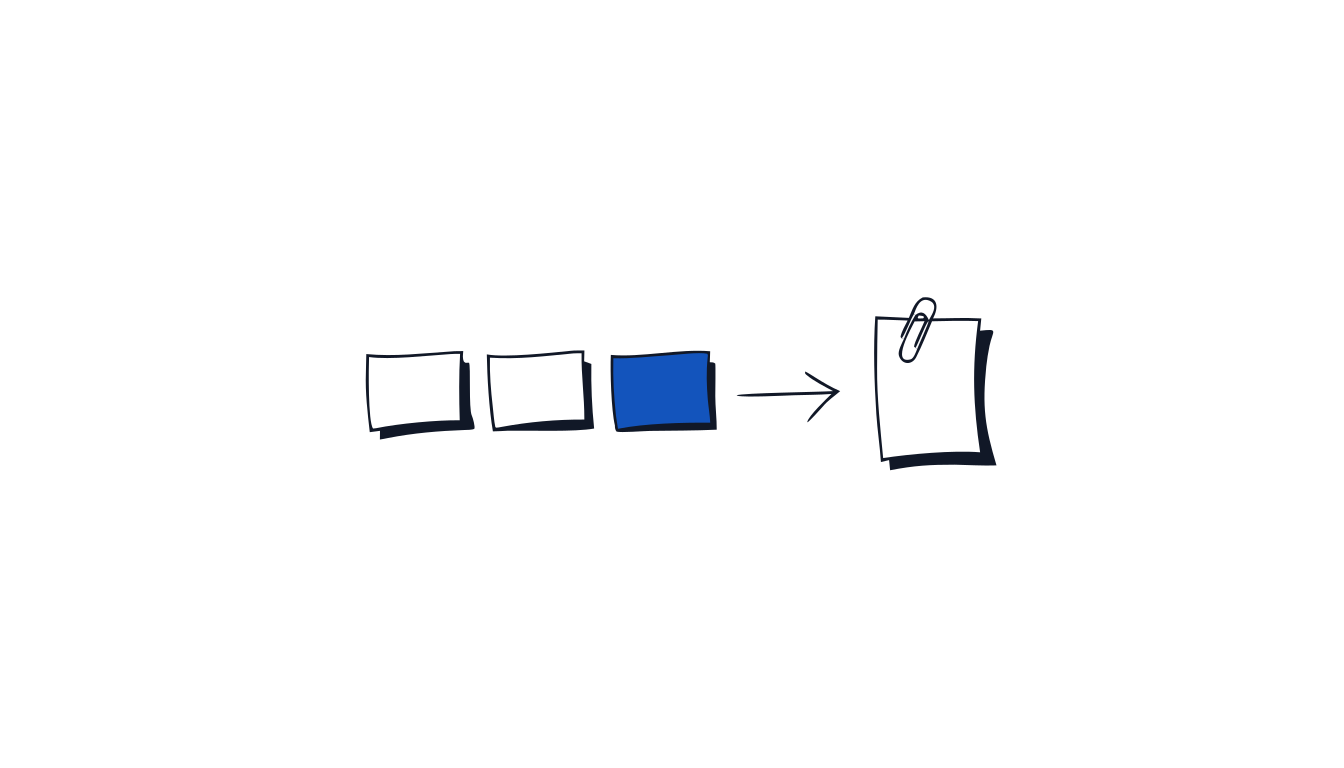
How do you turn a year of notes into a declaration?
This is the part that decides how good the finished document is, and it happens long before you sit down to write.
If you have kept short, dated entries as things happened, drafting is retrieval. You filter to the period the request covers, pull the entries that bear on the question, put them in order, and write around them. The dates are already right. The details are already specific, because you wrote them the same day rather than reconstructing them nine months later. It is an afternoon’s work.
If you have not, drafting is reconstruction, and reconstruction shows. Memory produces “often” and “constantly” because that is genuinely how it stores repeated events. It rarely produces 4 March at 5:52 p.m., and it is vulnerable in a way a contemporaneous record is not, because a note made at the time carries a reliability that a folder assembled for the hearing does not.
The practical advice is the unglamorous kind. Keep the entries short. Keep them boring. Write them the day they happen, including the ordinary days when nothing goes wrong, because the ordinary days are what establish the pattern the difficult ones stand out against.
Documented keeps a dated, sealed entry for each day as you go, so the facts behind a declaration are already there in a form a court can use. Entries stay on your device.
Can someone else write a declaration to support your custody court case?
Yes. Third-party declarations are common, and in custody court they can carry real weight when the person genuinely saw something.
The rules are the same for them: first person, personal knowledge, dated specifics, signed under penalty of perjury. A teacher, a coach, a childminder, a neighbour or a relative can describe what they observed. What they cannot usefully do is offer an opinion on who should have custody, and a declaration that mostly does that mostly gets discounted.
Ask for the specific thing the person actually knows about, not for a character reference. One paragraph from the swimming instructor about who brought the child every Tuesday for two years is worth more than a page about what a good parent you are.
Do not write it for them. It has to be in their words, and a set of declarations that read as though one person drafted them all is noticed.
Do you need a family law attorney, or can you draft your own?
You can draft your own, and a great many self-represented parties do. The document is not technically difficult, and courts are used to receiving them.
A family law attorney adds most where the stakes or the complexity are highest: when the other side is represented, when the facts are contested in a way that will lead to testimony, when there is a safety issue, or when you cannot tell which facts matter. An attorney will also know your local rules, which is exactly the knowledge a national guide cannot supply.
A middle path exists in most places. Court self-help centres and family law facilitators review declarations for form at no charge, and a limited-scope arrangement lets you pay an attorney to review a document you drafted rather than to run the whole case. If you are representing yourself, both are worth using early.
Whatever you decide, write the first draft yourself. Nobody else has the facts.
What happens after you file your declaration?
You file it with the clerk and serve a copy on the other party, within your court’s deadlines. Those deadlines are real and they are strict; a declaration filed late may not be read at all.
The other side may file a responsive declaration setting out their account. Depending on your court’s rules you may be permitted a reply declaration, usually shorter and limited to answering what the response raised rather than adding new material.
The judge reads the filings before the hearing. At the hearing the court may decide on the papers, ask questions, or set the matter for an evidentiary hearing where witnesses testify. If it goes that way you will be asked about your declaration, which is the last and best reason to make sure every line of it is something you can stand behind.
Frequently asked questions
What is an example of a simple declaration statement?
The declaration statement is the line above your signature. In most states it reads close to: “I declare under penalty of perjury under the laws of the State of [state] that the foregoing is true and correct.” The date and the city where you signed go with it. Use your state’s exact wording, which appears on the court form if one exists.
What is the best evidence for family court?
There is no single best kind. What tends to carry weight is specific, dated, ordinary material about your own parenting, kept consistently over time and produced in its original form. What tends to carry less is anything characterising the other parent, anything recorded covertly, and anything assembled shortly before the hearing.
Can you provide an example of a child custody declaration letter?
The shape is standard: caption and case number, a short paragraph identifying yourself and the children, numbered paragraphs of dated facts about care and the current arrangement, the specific orders you are asking for, and the penalty of perjury line above your signature. The facts have to be your own, which is the one part of it nobody can supply for you.
Do you have to notarize a declaration?
Generally not. A declaration signed under penalty of perjury is designed to work without a notary, which is the main practical difference from an affidavit. If your court requires an affidavit instead, you will need one. Check the form or ask the clerk.
References
This article explains general, well established concepts and is not legal advice. Documented is not a law firm. Whether your court uses declarations or affidavits, what it requires on the face of the document, page limits, filing deadlines and service rules all vary substantially by state and by court. Confirm specifics with an attorney licensed in your state or your court’s self-help center.
- 28 U.S.C. § 1746: Unsworn declarations under penalty of perjury
- Federal Rules of Evidence, Rule 602: Need for Personal Knowledge
- Federal Rules of Evidence, Rule 701: Opinion Testimony by Lay Witnesses
- Federal Rules of Evidence, Rule 1006: Summaries to Prove Content
- California Rules of Court, rule 5.111: Declarations
- Thurman W. Arnold, Arnold & Peterson, LLP: Tips For Drafting Family Court Declarations
- Anna M. Vujovic, Navigate Law Group: How to Write a Persuasive Family Law Declaration in WA State
Related articles
Documented is a private, tamper-evident record of how you show up for your kids. This article is general information, not legal advice, and Documented is not a law firm.